About Me

My photo
Alcalá de Henares, Madrid, Spain
I recently earned my Masters in History at NWMSU and am now working as a language assistant in a Spanish elementary school.
Showing posts with label Hieronymus Bosch. Show all posts

Thursday, March 25, 2010

My Parents Visit Spain: Part Dos

After our day in Segovia, I took my parents to see Toledo, the capital of the province of Castile-La Mancha, which I went to back in October. We left by train from Atocha and took a thirty-minute ride south of the city. When we stepped off the platform we were met with wonderfully warm weather. I had forgotton how beautiful the interior of the Mudejar-style train station was:
We got off a bus at Plaza Zocodóver, then walked up to the Alcázar. We stopped in some shops and looked at the Toledan crafts (swords and damascene). We returned to Plaza Zocodóver and looked at the shops selling marzipan. Here is the plaza:

We walked from here to a lookout point where you could see the river and the Alcázar in opposing directions:

This statue stood in front of the Alcázar:
The Alcázar was built in the 16th century atop the ruins of a Muslim fortress. It served as a military fort through much of its subsequent history and is most famous for its role in the Spanish Civil War. In 1936, Franco's Nationalist forces were besieged in the fortress. The Republicans held the son of the colonel commanding the troops inside the Alcázar and demanded the Nationalist officer surrender or his son would be killed. The colonel supposedly told his son to pray and to die like a hero as he refused to surrender. Some accounts claim the Republicans shot the colonel's son immediately after this while others claim he died later as a prisoner of war. Nontheless, the attempt at the siege failed and the building sustained heavy damage, being restored soon after.
After leaving the area of the Alcázar, we walked down some winding streets on our way to Toledo Cathedral (built from 1226-1493).

We finally emerged upon the Cathedral and spent some time in the plaza in front of it, taking pictures:
We went inside the Cathedral and saw some of its famous paintings including some by the famous Toledan resident, El Greco, along with Caravaggio, Raphael, and Rembrandt. We spent the rest of the afternoon wandering through the streets of Toledo, passing the house of El Greco and arriving in the old Jewish quarter. One of the things Toledo is most famous for is the flourishing culture in the early middle ages in which Jews, Christians, and Muslims lived in peace for several hundred years. Beside the former synagogue stood this statue of Samuel HaLevi, a Jewish poet, theologian, and warrior from southern Spain who lived in the early 1000s:
We passed through some neighborhoods with horseshoe-arch doorways inspired by Arabic design. Not far from here I dropped my camera and the focus broke on it. My parents bought me a new camera as my birthday gift after this, for which I am extremely thankful. We left Toledo and returned to Madrid where we ate at a little bar near Museo Reina Sofia. I ordered octopus in marinara.

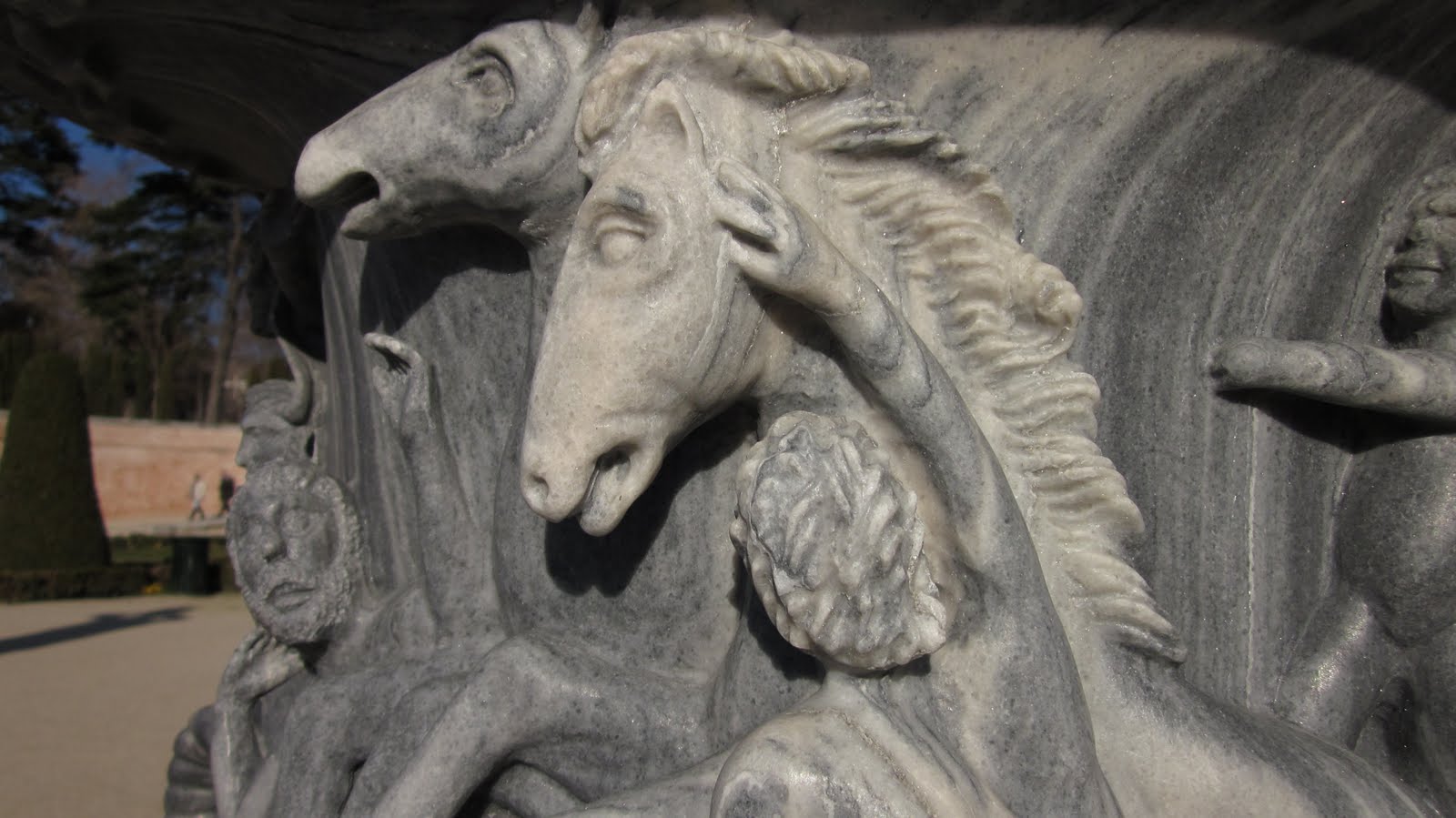
The next day I had to work, but met my parents after school and we went to Madrid. We spent most of the afternoon walking through Parque Retiro. I tried out the new camera here:
We admired the crystal palace and the pond in the park.

The next day I got off work and met Mom and Dad at the train station near my apartment. We went to lunch at a tapas bar I had never tried before which was away from the city center, past the Cathedral. We then walked around town some more before I left for tutoring. After that I met up with them at Plaza Cervantes and we took the train into Madrid. We visited the Prado and got to see most of the main exhibits: Goya, El Graco, Velazquez, and Bosch. After the museum closed, I took them to Malasaña, where we walked around the nightlife and ate at a tapas bar, which was very good. I ordered migas, breadcrumbs, sausage, ham, and potatoes fried together. After dinner, we visited the Belgian bakery nearby where Dad and I got a coffee.

The next day I met Mom and Dad at the train station after work and I took them in to see the apartment. We went to Madrid to see the Harley shop in the AZCA district. We got some pictures of Plaza Castellana from here:

After this we took the metro to Plaza de España and took pictures of the monument to Spain's Siglo de Oro (Golden Century) the 1600s, when Spain's economy was falling, but its cultural accomplishments thriving. The monument shows figures representing the Empire on one side and Cervantes and his fictional creations on the other.
We walked from here to the Egyptian Temple of Debod and took pictures as the sun set:
After the temple, we walked to the gardens of the Palacio Real and took pictures of the garden and palace grounds:

We then walked into the center of Madrid, heading to Plaza Mayor where we were going to eat at Museo de Jamon again. On the way there, we ran into Cody along with Nicole and Lindsay (friends of ours who were also visiting that week). They were leaving an Irish pub, celebrating St. Patrick's Day. We all stood outside Plaza Mayor and talked for a long while, noting how strange it was for us to bump into one another. We parted after this and Mom, Dad, and I went to eat. This was their last night in Spain and I was very sad to see them go. It was a lot of fun being with them and showing them the things I had been doing and seeing the past months.

Tuesday, December 8, 2009

The Story of the Ham and the Palace

Cody and I made a new purchase this week: a cured ham from the local grocery store. Usually such hams are quite expensive as it is one of Spain's most renowned delicacies. This one was cheap because several of the grocery stores are offering discounts on their hams. Ours came with two types of sausage, cured pork, and some Danish butter cookies. We also bought a stand for the ham and a knife set. We have been eating from it all week, making sandwiches, or just having it plain. Here I am with the new addition:
The students at school are studying for the Trinity exam, an oral test determined to judge their comprehension of the English language. This means I have been studying with the kids for the exam all week. I take them outside the classroom individually and ask them questions. Some of them are very good. I asked one kid where he went on his holiday and he said, "I went to Asturias." "What did you see?" I asked as a follow-up question. "I saw," he said, then paused and shrugged with a confused look on his face, "I saw Asturias."

I had a long weekend this week. I normally have Fridays off and Monday was the Day of the Immaculate Conception while today is Constitution Day. Sunday I had lunch with Cody, Liz, James, and Priscilla. Our group was smaller this week as the others either went home for the break or on trips. I ate paella (a traditional Spanish dish from Valencia made with seafood, rice, and seasoned with saffron), roast lamb, and had something called leche frita for dessert (literally fried milk). I also tried a dish this week of squid and rice, with the squid's ink. I liked it and will probably order it again.

Sunday night a group of us went in to Madrid and walked around. We went to Plaza Mayor, which was extremely crowded and filled with stalls selling Christmas decorations:
We then walked to the Royal Palace and Catedral de la Almudena:
Yesterday, Cody, Jacqui, and I took a train to El Escorial in the northwest corner of the Madrid province. The train took about two hours to get there as we made several stops along the way. It had rained earlier that day, so a thick fog stood over everything. The town is situated in the foothills of the Sierra de Guadarrama and is named after the sixteenth-century palace of King

Felipe II (Philip II), the son of the Holy Roman Emperor Charles V (Carlos I of Spain). Felipe II ruled Spain through the peak of its imperial power, and the granduer of his palace shows this. It was built between 1563 and 1584 and served as a summer hunting home for Felipe and his family, and also holds a monastery. This symbolized the combined rule of the state and the Catholic Church in Spain (which was evidenced by the Spanish Inquisition). Here are some pictures of the palace, San Lorenzo de El Escorial:
We went inside the palace, which was amazing. We first walked through the basement, where several artifacts from the construction of the palace were on display, including the original blueprints and pieces of the wooden cranes used to lift the stones. The next rooms housed some private art collections of the palace. These were mostly replicas of original artworks, but some were unique, including a large painting by El Greco. After this, we entered the main part of the palace and saw the bedroom of Felipe II. The bed he died in (in the year 1598) was still in its original location and had never been moved. We also walked through a door with ornate wooden carvings and into a long room lined with windows overlooking the gardens. This was "the strolling room" where Felipe II and his children (including future king Felipe III) would take walks during the sunset. We also walked through the mausoleum where many of the royal princes and princesses are buried. In a larger chamber lie the bodies of all the Spanish monarchs from Carlos I (1500-1558, whose body was moved here by his son) to Alfonso XIII (1846-1941, who was ousted from the throne a few years before the Spanish Civil War). The mausoleum included many marble statues and tombs. We walked from this room to the central cathedral of the monastery. This was one of the most impressive cathedrals I have ever been in. It followed the desornamentado architectural style of the outside of the church, which means it was not adorned with many decorative pieces. Instead, it was enormous with what seemed to be limitless space moving upwards to the top of the domed roof. The altar was equally large, reaching nearly to the faraway ceiling and containing several original Renaissance paintings of the life of Christ. From the cathedral, we walked to the courtyard and into the private library of Felipe II. This was a long room with thousands of gold-leafed books lining the walls. Above the bookcases were paintings of several Greek and Roman philosphers and mythological figures. Paintings of the seven muses covered the ceiling, and in the center of the room were lined up several globes and a Ptolemaic sphere of the heavens.

After leaving the palace, we walked around town, looking for a place to eat. The town was quite nice (it appeared to be a wealthy area) and we found a restaurant where I had octopus. Here is a picture of the streets of El Escorial:
Today I wanted to go to the Museo Thyssen-Bornemisza (considered one of the three greatest art museums of Madrid along with the Prado and Reina Sofia). I got there around four o'clock, but decided to go to the Prado instead when I saw the line reached three blocks from the entrance. (The museum was having a special exhibition that day). First, I went to Parque del Retiro and saw the Crystal Palace, a decorative element of the park:

At the Prado, I saw the rest of the Goya paintings I hadn't seen last time, including his black paintings: Saturn Devouring His Son, Fight With Clubs, and The Dog. These were dark-themed portraits of mythology and the Bible with themes of cannibalism, unending battle, and loneliness. These were done when Goya grew older and more reclusive and originally decorated his own dining room. I also saw his paintings, The Second of May and The Third of May, which showed the Spanish uprising against the Mamelukes (Turkish soldiers who fought for France in the Napoleonic Wars) and the equally brutal reaction of the French soldiers the following day. This is the most famous work of Spanish nationalist art. I also saw several paintings by the Italian Renaissance painters Raphael and Bocaccio as well as the German Renaissance painters, Lucas Cranach the Elder and Albrecht Dürer, including his famous self-portrait with gloves. The bizarre works of the early Dutch painter, Hieronymus Bosch, were also at the museum, including his most famous painting, the triptych titled, The Garden of Earthly Delights. The painting depicts heaven, an earth full of sin, and hell. It was painted in the early 1500s, but resembles something from the surrealist period of the early 2oth century. There are so many details and strange images that it would take nearly an hour to take everything in. Some examples are a fish eating a man, people carrying giant strawberries on their backs, and an animal somewhere between a kangaroo, a dog, and a rabbit. While I was walking through the museum's room of Spanish historic-themed art, I saw someone I thought looked familiar. I realised after a few minutes that it was Fabrizio Moretti, the drummer for The Strokes. He was talking with a member of his other band about a painting of a woman who refused to kiss her dead husband's body at the funeral. "Sounds familiar," he said. Apparently, he and his side-project, Little Joy, are having a concert in Madrid tomorrow night.
After the museum, I walked around Paseo del Prado and looked at the odd Madrid Christmas lights and Christmas trees. I plan to travel through the city sometime, taking pictures of all the Christmas trees (one is made of several pieces of illuminated smoked glass, another of pink flowers, and another looks like a pyramid with four LED screens displaying a moving game of Pac-Man). After this, I returned to Alcalá, ate at a kebab place, and returned to my apartment.
I have a short week this week, return for a full week in which I work all five days (I told Emma I would work her Friday so she could fly to England early for Christmas break). After that, I am done for three weeks. Cody and I bought plane tickets to Rome for the 29th of December and will be spending nine days there, touring the city over New Year's and visiting nearby places, such as Florence.