About Me

My photo
Alcalá de Henares, Madrid, Spain
I recently earned my Masters in History at NWMSU and am now working as a language assistant in a Spanish elementary school.
Showing posts with label Alcalá de Henares. Show all posts

Wednesday, May 26, 2010

The Return to Alcalá de Henares

I returned to Spain from my two spring break trips and went straight back to my normal schedule of teaching and tutoring. The kids were excited to hear about my trips, and many of them did not know where Stockholm was. We had two student teachers begin at the school after spring break, Alba and Charo. They were both very nice and hung out with all the language assistants in the breakroom.

In the first week of April, we celebrated Kelsey's birthday. We started the celebration with some wine and food at Parque O'Donnell in Alcalá. This eventually turned into a very disorganized, but fun game of American football followed by my failed attempt to play a game of soccer with Jeff, James, and Kevin:

Afterwards we went to Kevin, Jeff, and James' apartment for a surprise party. We all pitched in for cupcakes and ice cream. Here's Kelsey soon after the surprise:

There were a lot of us at the party and Kelsey's friend, Sarah, who teaches in El Escorial, came to visit. Here Kevin, Sarah, and Lindsay enjoy the birthday cupcakes:

We then spent the night wandering through Alcalá from tapas bar to tapas bar, and then from club to club. The next day I introduced Kelsey and Lindsay to this movie:

The Room is definitely the worst movie ever made, but it is so bad that you cannot look away and find yourself laughing constantly at its misinterpretation of human nature. Both Kelsey and Lindsay were so entranced by the movie that we ended up inviting Jeff, James, and Kevin over to watch it again that night. Several other viewings have followed since then.

We also visited the Henares River on several occasions. On the second weekend of April we visited the river on both Saturday and Sunday. Sarah had come down to visit us again that weekend. We bought Turkish döner kebabs on Saturday and ate them beside the river, taking some time to relax. In this picture Lindsay, Kevin, Sarah, James, and I siesta by the river along with some Spaniards:

After our period of relaxation, James and I crossed the cold river to visit the ruins of the Muslim castle which Cody, Kevin, and I had visited last fall. The next day we returned to the river for another picnic. James and I went across the river again, this time with Jeff and Kelsey. We spent quite a bit of time exploring the ruins and admiring the view of Alcalá.

Monday, April 12, 2010

Mountain Visits and Park Parties

I haven't posted anything in a while as I've been extremely busy and went on a couple of trips over my spring break. Before I get into those trips, here's a little bit about some things I did the week before.

First of all, I went to the Guadarrama Mountains in the province of Castilla y León, near Segovia. I went one Saturday morning with Emma, Jackie, Becky, and Gavin. We took a train to the town of Cercedilla in the northwestern corner of the Madrid province. The town rested at the foot of a high mountain and we had lunch there at a small diner. We took another train further up the mountain. This train had been in operation since the 1920s and ran quite slow as it ascended the mountain. The higher we got, the more snow we entered upon. We opened the windows of the train and stood most of the trip, enjoying the view of the mountains. Here is a picture of the girls on this old train (left to right: Emma, Jackie, and Becky):

This is a shot taken from the train:

Once at the top (an area known as Los Cotos), we walked down some roads, watching as families sledded down hills. We took some excursions into the snow at the side of the roads, one of which resulted in Emma loosing a shoe in the snow. It was later recovered, but stuffed with ice. Here's a picture of Becky, Gavin, and I on one of these meanderings. You can tell by our faces how sure we were of our decision to walk though (in some places) knee-deep snow:

Only Jackie brought the proper footwear:

After getting wet feet, we walked to a ski lodge to warm up and have some coffee. Here's Gavin, Becky, and I outside this building:

It was nice to visit Los Cotos. Once there, you lost the feeling that you were in central Spain and so near a busy capital city. It was very quiet with a lot of fresh air (which is something of a rarity in the Madrid region).

Later that week we had our Easter celebration at school. For two days we worked doing activities with the kids. The first day we did things for the younger children, pre-school (infantil) to second grade. I was in charge of musical hoops, which we played similar to musical chairs in which the kids had to dance around a series of hoola-hoops and jump inside them when the music stopped. Few of the younger kids really understood how to play, but they were funny to watch. Later, I read the story, Peter Cottontail to the infantiles. I asked one group, which seemed to understand very little English, if they liked the story. "No," said one kid with a blank expression, which made me laugh.

The next day we worked with the older kids (third to sixth graders). I was in charge of trivia all day. I read a series of Easter-related trivia questions to the kids, who were split into groups of three as they vied for points. It was kind of scary how serious they took the whole point-earning thing, especially since their prize consisted of me telling their group that they won. This was always followed by shouts of "Toma!" ("Alright!") and "Jolín!" ("Shoot!")

Starting that week we began a new tradition of picnics in Parque O'Donnell, which is just a short walk from our apartment. (I'm still not sure why the park has an Irish name). It's a nice park with large areas of shade as well as some open spaces. Emma, Kelsey, Lindsay, Jeff, James, and Kevin came to this first picnic (Cody was on a trip to Brussels that weekend). Here we are preparing our meal (left to right: me, Kelsey, Lindsay, James, Kevin, and Jeff):

and a group picture of us from later in the night:

Thursday, March 25, 2010

My Parents Visit Spain: Part Dos

After our day in Segovia, I took my parents to see Toledo, the capital of the province of Castile-La Mancha, which I went to back in October. We left by train from Atocha and took a thirty-minute ride south of the city. When we stepped off the platform we were met with wonderfully warm weather. I had forgotton how beautiful the interior of the Mudejar-style train station was:
We got off a bus at Plaza Zocodóver, then walked up to the Alcázar. We stopped in some shops and looked at the Toledan crafts (swords and damascene). We returned to Plaza Zocodóver and looked at the shops selling marzipan. Here is the plaza:

We walked from here to a lookout point where you could see the river and the Alcázar in opposing directions:

This statue stood in front of the Alcázar:
The Alcázar was built in the 16th century atop the ruins of a Muslim fortress. It served as a military fort through much of its subsequent history and is most famous for its role in the Spanish Civil War. In 1936, Franco's Nationalist forces were besieged in the fortress. The Republicans held the son of the colonel commanding the troops inside the Alcázar and demanded the Nationalist officer surrender or his son would be killed. The colonel supposedly told his son to pray and to die like a hero as he refused to surrender. Some accounts claim the Republicans shot the colonel's son immediately after this while others claim he died later as a prisoner of war. Nontheless, the attempt at the siege failed and the building sustained heavy damage, being restored soon after.
After leaving the area of the Alcázar, we walked down some winding streets on our way to Toledo Cathedral (built from 1226-1493).

We finally emerged upon the Cathedral and spent some time in the plaza in front of it, taking pictures:
We went inside the Cathedral and saw some of its famous paintings including some by the famous Toledan resident, El Greco, along with Caravaggio, Raphael, and Rembrandt. We spent the rest of the afternoon wandering through the streets of Toledo, passing the house of El Greco and arriving in the old Jewish quarter. One of the things Toledo is most famous for is the flourishing culture in the early middle ages in which Jews, Christians, and Muslims lived in peace for several hundred years. Beside the former synagogue stood this statue of Samuel HaLevi, a Jewish poet, theologian, and warrior from southern Spain who lived in the early 1000s:
We passed through some neighborhoods with horseshoe-arch doorways inspired by Arabic design. Not far from here I dropped my camera and the focus broke on it. My parents bought me a new camera as my birthday gift after this, for which I am extremely thankful. We left Toledo and returned to Madrid where we ate at a little bar near Museo Reina Sofia. I ordered octopus in marinara.

The next day I had to work, but met my parents after school and we went to Madrid. We spent most of the afternoon walking through Parque Retiro. I tried out the new camera here:
We admired the crystal palace and the pond in the park.

The next day I got off work and met Mom and Dad at the train station near my apartment. We went to lunch at a tapas bar I had never tried before which was away from the city center, past the Cathedral. We then walked around town some more before I left for tutoring. After that I met up with them at Plaza Cervantes and we took the train into Madrid. We visited the Prado and got to see most of the main exhibits: Goya, El Graco, Velazquez, and Bosch. After the museum closed, I took them to Malasaña, where we walked around the nightlife and ate at a tapas bar, which was very good. I ordered migas, breadcrumbs, sausage, ham, and potatoes fried together. After dinner, we visited the Belgian bakery nearby where Dad and I got a coffee.

The next day I met Mom and Dad at the train station after work and I took them in to see the apartment. We went to Madrid to see the Harley shop in the AZCA district. We got some pictures of Plaza Castellana from here:

After this we took the metro to Plaza de España and took pictures of the monument to Spain's Siglo de Oro (Golden Century) the 1600s, when Spain's economy was falling, but its cultural accomplishments thriving. The monument shows figures representing the Empire on one side and Cervantes and his fictional creations on the other.
We walked from here to the Egyptian Temple of Debod and took pictures as the sun set:
After the temple, we walked to the gardens of the Palacio Real and took pictures of the garden and palace grounds:

We then walked into the center of Madrid, heading to Plaza Mayor where we were going to eat at Museo de Jamon again. On the way there, we ran into Cody along with Nicole and Lindsay (friends of ours who were also visiting that week). They were leaving an Irish pub, celebrating St. Patrick's Day. We all stood outside Plaza Mayor and talked for a long while, noting how strange it was for us to bump into one another. We parted after this and Mom, Dad, and I went to eat. This was their last night in Spain and I was very sad to see them go. It was a lot of fun being with them and showing them the things I had been doing and seeing the past months.

My Parents Visit Spain: Part Uno

Two weeks ago my parents arrived for a weeklong visit. Their flight came in on a Wednesday and I met them at the airport and helped them get their luggage to Alcalá. We checked into their hotel in La Garena, then went for some tapas at El Tapón which was nearby. After this we took a walking tour of Alcalá. We got to see the main sights in the town including the old city wall, the Cathedral (which we went inside of), Calle Mayor, Palacio Arzobispal (where Christopher Columbus met with Queen Isabel on the subject of financing his voyage to the Americas), Plaza Cervantes, and Alcalá Universidad. Afterward we ate at an American restaurant near their hotel, Pinky Burger. They were quite tired from their long voyage over the Atlantic so they went to bed after this. It was great to see them and I was very excited about planning an itenerary for the rest of the week.

The next day I met them for lunch at Indalo in Plaza Garena. I took them over to the big department store in La Garena, El Corte Inglés (The English Cut). We looked at some of the strange European appliances there such as irons with a hose connected to a steam pump. Later that evening we went to Madrid. We took the metro from Atocha to Puerta del Sol where we saw many street performers such as the decapitated-head-on-the-table-man who scared passersby with sudden shouts and the street-sweeping-living-statue. Dad enjoyed watching these people get scared and took some video of it. After a look around this lively center of Madrid we headed down the street to Plaza Mayor where Mom and Dad took some pictures of the 17th century buildings. We went to Mercado San Miguel after leaving the plaza and saw some amazing things: local foods, giant chocolate egg sculptures, and a man making intricate designs in espresso foam with a stylus dipped in chocolate syrup. This was one of Mom's favorite places we visited. We ate at the Museo de Jamón on Plaza Mayor. We sat in the basement and ate next to a group of Italians. Mom ordered a roast chicken, Dad had a fried whitefish, and I had a plate of Iberian ham and cheese.

I had the whole of the next day off work. I met Mom and Dad at their hotel and we went to Casa de Hippolytus, the ruins of what was once the academy of the ancient Roman town of Complutum, which sat on the site of present-day Alcalá de Henares. The ruins were discovered not long ago and were better preserved than some of the excavated Roman houses in Rome itself. We and at Casa Rojas then went to the village of Chinchón via bus from Madrid. It was nice to visit the town again and to show Mom and Dad around. We went into a food store I had visited the last time. The same old man who had talked me into buying a bottle of anís last time took us around his shop and showed us all the local products. We bought some olives and almonds thanks to his salesmanship. After this we walked around Chinchón's Plaza Mayor/bull ring. We went into a bakery and bought some pastries from a woman who seemed rude at first, but warmed up to us soon. She asked us where we were from, then told us she had some apple, strawberry, and kiwi pastries ready to come out of the oven if we wanted to wait. She had several intricately designed breads on display, molded and twisted into flowers, wreathes, and the crest of the local soccer team, Real Madrid. She asked us to follow her around the back of the store where she took us to see the ovens and the fresh pastries she mentioned. We bought one of the strawberry ones. We walked through the town some more, stopping in another food shop. Out front an old man cut up cardboard boxes and put them in a bin. While inside the store I noticed him walk inside, grab a beer from the cooler, and return outside to continue his work. Dad bought some sunflower seeds here (a popular item in Spain). We walked from here to the castle atop the hill, then wandered around the outskirts of town before catching the next bus into Madrid. In Madrid we went to Gran Vía and walked up and down the crowded streets, looking at the art deco and art nouveau architecture. We also stopped by an outdoor market which displayed items from different regions of Spain. We tried some Manchego cheese (Spain's primary cheese export, made from goat's milk) and some cider (sidra) from Asturias (a province in the north). We then went to Paseo del Prado and ate at a bar. The bartenders here wore black waistcoats and bowties and were more concerned with whistling to dogs and watching the Barcelona vs. Valencia game than serving the customers, but they were funny stereotypes of Spanish waiters (two old men with wry looks and a younger man who seemed to be in training). They seemed to come straight from a Hemingway short story.

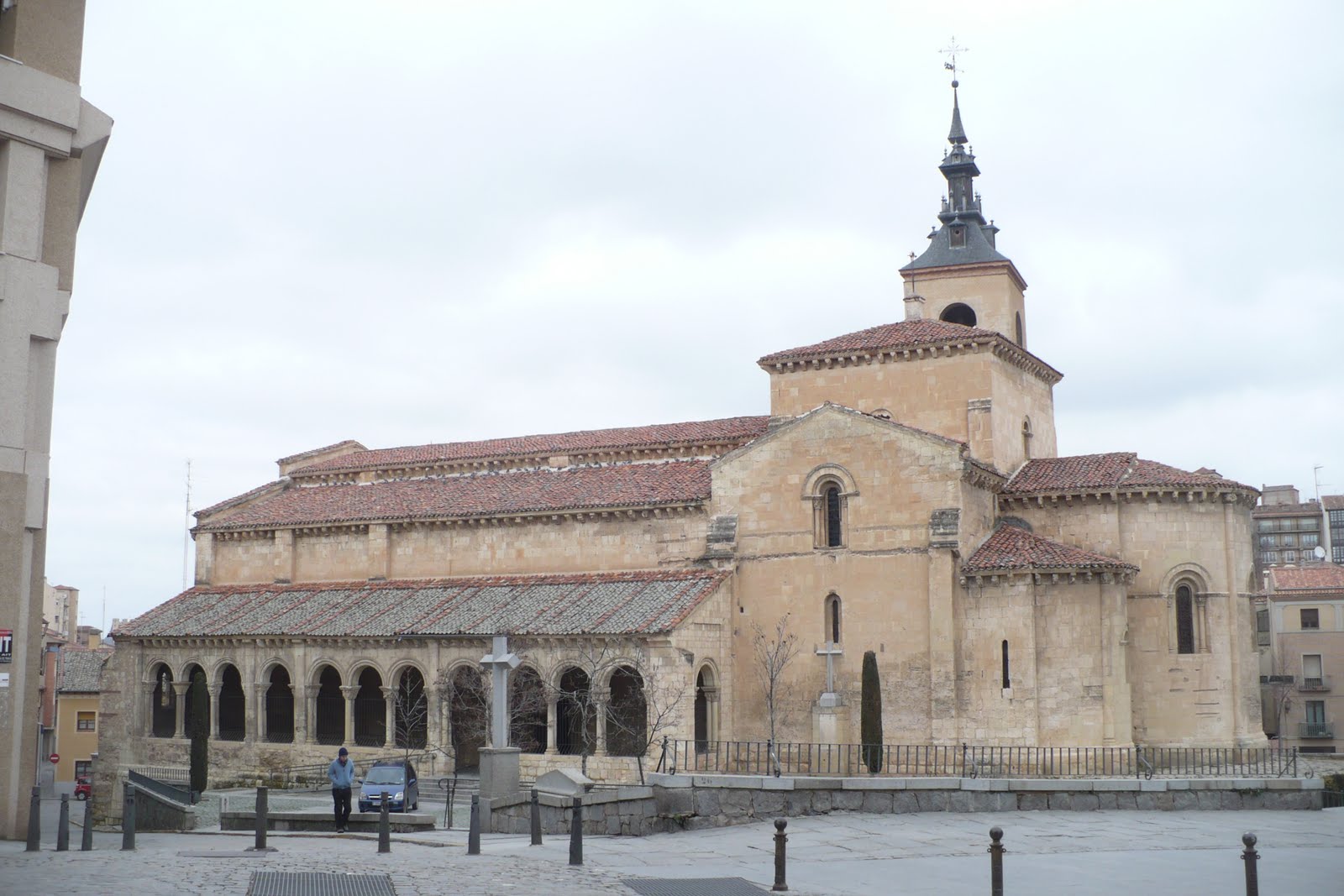
The next day we went to Segovia. We had to buy our tickets and catch the train at Chamartín on the northern side of Madrid. The train moved fast and got us to Segovia in thirty minutes. Along the way we viewed the mountains of the Guadarramas and the darkness of two tunnels as we passed beneath some mountains. From the train station we had to catch a bus into the town. We ate a chain restaurant called Pan & Company. We finished our food and coffee then headed out, seeing this 11th century church:

It was quite a bit colder in Segovia so we bought some gloves and hats at a store in town. As we walked down the street, we emerged upon this amazing sight:
This is the Roman Aqueduct of Segovia, constructed sometime between the year 50-110. This is one of the largest and best-preserved aqueducts outside Italy. It is over ten miles in length. An aqueduct was a marvel of Roman engineering which served as a plumbing system. It carries fresh water from a source (in this case the Guadarrama Mountains) to a settlement by means of a pipe located through the top of the gradually-declining sloped structure. The aqueduct was built without mortar. The Romans invaded in the first century AD and took Segovia from the Celtiberians, the ancient people who likely gave the town its name. Monuments such as this and the road systems in Spain are the legacy of the Romans, along with the Spanish language, which is derived from Latin. We climbed a set of stairs near the aqueduct and took some more photos:

We walked further into town from here, past a former mansion called La Casa de los Picos which is now an exhibition hall which features traveling displays:
We walked further down a street then emerged upon a Plaza dedicated to Juan Bravo, a rebel from the 1500s. Bravo was from Segovia and led a group against King Carlos I (Holy Roman Emperor Charles V) in the Castilian War of the Communities. The Comuneros, as they were known, fought against the king whom they saw as a foreign invader who imposed high taxes, and against the feudal system of lords and vassals. Bravo and his followers were defeated and executed in 1521. Here is the plaza dedicated to him:
We walked down some winding streets of the old Jewish quarter, past a former synagogue which had been converted into a church soon after the expulsion of the Jews in 1492. (The Spanish Jews, known as the Sephardim, left for the Netherlands, North Africa, and Brazil. They are still a major Jewish community in some places ).

We soon came upon the Cathedral of Segovia, Catedral de Nuestra Señora. From the street, the several spires rising from the back of the building look like a stone pine forest:
The cathedral was built in the late 1520s. It's front was impressive as well:

We then went inside this Gothic cathedral, constructed after the Castilian War of the Communities. We admired the stained-glass windows, the highly decorative and colorful altars, and high, columned vaults:

We then went to the Plaza Mayor and had coffee at a little café. From here, there was a good view of the Cathedral:

We walked past the Cathedral until we came to the Alcázar of Segovia, a large, fairy-tale style castle originally constructed in the 12th century and later renovated in the 1800s. The castle was originally a fortress. (alcázar is one of many Spanish words adopted from Arabic. It means "fortress," and also serves as the root of the name of Alcalá de Henares). It was later a royal residence and a military academy. Here is a view of the outskirts of the town from the high cliff on which the Alcázar stands:
Here is the Alcázar itself:

The inside of the castle was amazing. There were suits of armor:
Islamic-inspired ornamentation:
and weaponry:

Here is a view of the towers fromt the courtyard:
We then climbed a (at the time) seemingly unending spiral staircase to the highest tower of the Alcázar. The staircase was narrow and at times this was difficult with people coming up and going down. However, from the top there was a beautiful view of the city and the Cathedral:
There was also a good view of the castle spires and countryside:

We left the castle and headed back through town to the bus stop, getting another look at the Cathedral and Aqueduct along the way. We arrived back in Madrid and looked around for a place to eat before deciding upon returning to La Garena and eating at Gino's, an Italian restaurant. We finished dinner late (as most Spanish people do) and went to bed to prepare for the next day.